

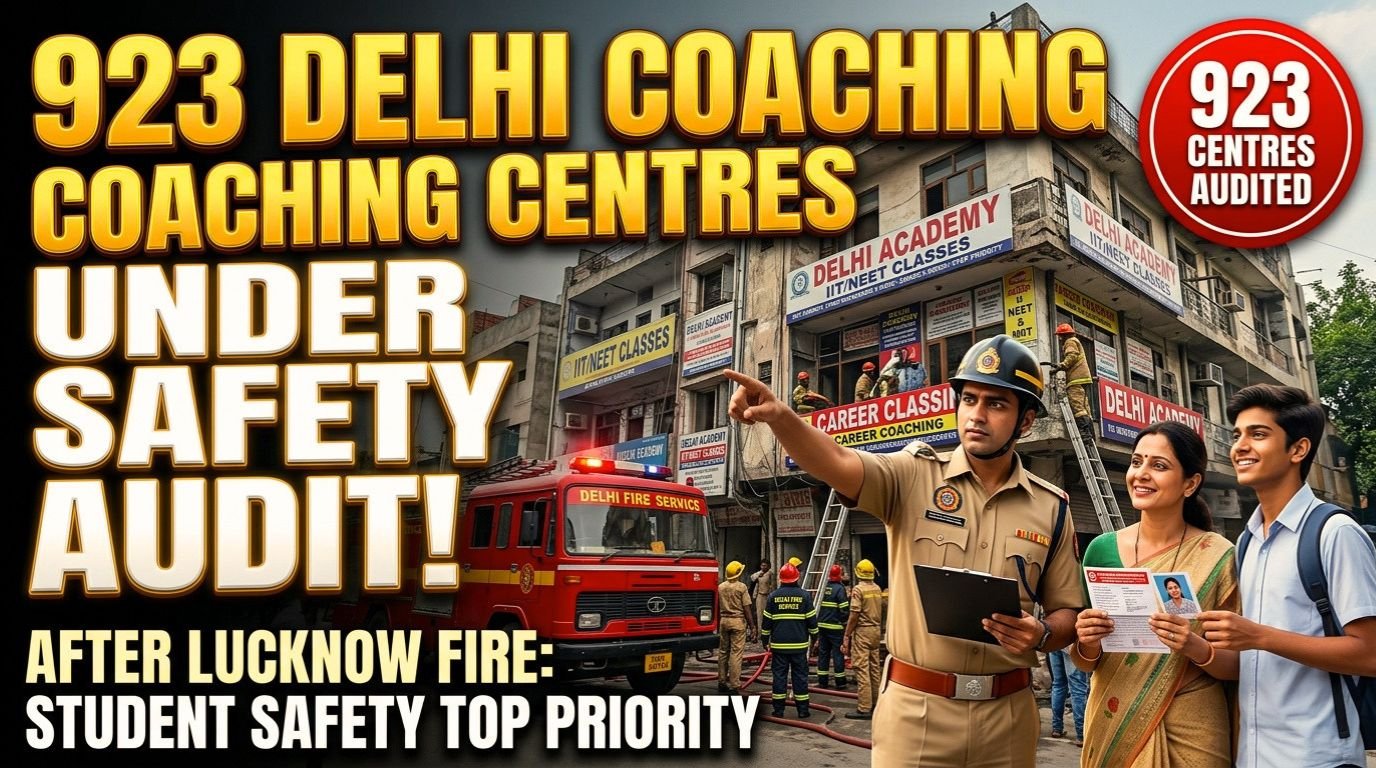
923 Delhi Coaching Centres Safety Audit After Lucknow Fire Incident
Education has always been one of the strongest foundations for building a successful future. Every year, thousands of students travel to Delhi from different parts of India to prepare for competitive examinations such as UPSC, SSC, Banking, NEET, JEE, CUET and many other government recruitment exams. Because of this growing demand, hundreds of coaching institutes have been established across the national capital.
However, recent incidents related to fire safety have once again raised serious questions about whether educational institutions are fully prepared to protect students during emergencies. Following the tragic fire incident reported in Lucknow, authorities have now decided to carry out safety inspections of hundreds of coaching institutes in Delhi. According to officials, nearly 923 coaching centres will undergo a detailed safety audit to verify whether they are following fire safety norms and emergency preparedness guidelines.
The decision has attracted nationwide attention because student safety has become one of the biggest concerns in educational institutions.
Why the Safety Audit Has Been Ordered
Every year, thousands of students spend long hours inside coaching institutes. Some coaching centres operate from multi-storey commercial buildings while others function from basements or narrow lanes where emergency evacuation can become difficult during accidents.
Recent fire-related incidents have highlighted the importance of proper safety arrangements. Authorities believe that preventive action is always better than waiting for another emergency.
The proposed safety audit is expected to examine whether coaching institutes have installed proper firefighting equipment, maintained emergency exits, followed building safety regulations and trained staff to handle emergency situations.
The objective is not only to identify violations but also to encourage educational institutions to improve their safety standards before any unfortunate incident occurs.
Student Safety Is More Important Than Ever
Students who leave their hometowns to prepare for competitive examinations often spend eight to ten hours every day inside coaching centres. Many also stay in nearby hostels or paying guest accommodations.
Parents send their children to these cities with dreams of a better future. Naturally, they expect educational institutions to provide a safe learning environment.
Safety inside coaching centres should never be treated as an optional responsibility. Just like quality education, proper emergency preparedness is equally important.
The recent developments have reminded everyone that education and safety must go hand in hand.
What Officials May Check During the Inspection
During the upcoming safety audit, inspection teams are expected to examine several important areas inside coaching centres.
These may include:
- Fire extinguishers installed at appropriate locations
- Functional fire alarm systems
- Emergency exit doors
- Clearly marked evacuation routes
- Electrical wiring conditions
- Capacity of classrooms
- Building approval documents
- Fire department clearance certificates
- Emergency lighting systems
- Staff awareness regarding emergency response
Authorities may also verify whether institutes are following occupancy limits instead of overcrowding classrooms beyond their approved capacity.
Why Coaching Centres Need Better Safety Standards
The coaching industry has expanded rapidly over the last decade.
Cities like Delhi, Kota, Hyderabad, Prayagraj, Patna and Lucknow have become major educational hubs where thousands of coaching institutes operate every year.
While many reputed institutions invest heavily in infrastructure and student safety, smaller institutes sometimes function from rented commercial buildings that were not originally designed for educational purposes.
As student numbers continue increasing, maintaining proper safety standards becomes even more essential.
Experts believe every institute should regularly inspect electrical systems, maintain firefighting equipment and conduct mock evacuation drills for both students and employees.
Importance of Fire Safety Awareness
Installing fire extinguishers alone cannot guarantee complete safety.
Students and staff should also know how to respond during emergencies.
Simple awareness can save many lives.
Every coaching institute should organize regular safety awareness sessions where students learn basic emergency procedures such as:
- Remaining calm during emergencies
- Identifying emergency exits
- Avoiding overcrowding while evacuating
- Informing authorities immediately
- Helping others without creating panic
These small preparations can make a significant difference during unexpected situations.
Role of Building Owners
Safety is not only the responsibility of coaching institutes.
Building owners also play an equally important role.
Commercial buildings rented for educational purposes should comply with structural safety standards, electrical safety regulations and fire prevention measures.
Proper maintenance of lifts, staircases, electrical panels and emergency lighting should be carried out regularly.
Ignoring maintenance for long periods may increase safety risks.
Parents Are Also Becoming More Aware
In recent years, parents have started paying greater attention to infrastructure before enrolling their children in coaching institutes.
Earlier, most admissions depended mainly on faculty reputation and examination results.
Today, parents are also asking important questions such as:
- Does the institute have fire safety clearance?
- Are emergency exits available?
- Is the building legally approved?
- How many students are allowed in one classroom?
- Does the institute conduct safety drills?
This changing mindset may encourage educational institutions to improve their infrastructure standards.
Government’s Focus on Prevention
Governments across different states have increasingly emphasized preventive inspections rather than taking action only after accidents occur.
Regular audits help authorities identify shortcomings before they become serious risks.
If coaching institutes address these observations quickly, students may benefit from much safer learning environments.
Experts believe periodic inspections should become a routine process instead of one-time activities.
Technology Can Improve Safety
Modern technology can also strengthen emergency preparedness.
Many institutions are now adopting:
- Smart smoke detectors
- Automatic fire alarm systems
- CCTV monitoring
- Digital attendance systems
- Public announcement systems
- Mobile emergency notification services
These technologies help staff respond faster during emergencies while improving coordination among rescue teams.
Better Infrastructure Means Better Confidence
Students perform better when they feel secure.
A safe classroom environment allows them to focus completely on their studies without unnecessary concerns.
Similarly, parents also gain confidence when educational institutions demonstrate their commitment to student welfare.
Investing in safety should therefore be viewed as an investment in educational quality rather than an additional expense.
Fire Safety Should Become Part of Education
Many experts believe basic disaster management and fire safety awareness should become part of orientation programs conducted by coaching institutes.
Even a short training session can help students understand:
- Emergency evacuation procedures
- Fire extinguisher basics
- Emergency contact numbers
- Safe assembly points
- Personal safety precautions
Knowledge remains one of the most effective tools during emergencies.
Challenges Faced by Older Buildings
Some coaching institutes operate from older commercial buildings constructed years before modern fire safety standards became more stringent.
Renovating such buildings can sometimes be technically challenging.
However, experts suggest that necessary improvements should never be delayed if student safety is involved.
Proper ventilation, wider escape routes and updated electrical systems can significantly reduce risks.
Creating a Culture of Safety
Safety should not be treated as a one-time inspection requirement.
Instead, it should become part of an institution’s daily culture.
Management, teachers, administrative staff and students all share responsibility for maintaining safe surroundings.
Simple practices like keeping corridors clear, avoiding blocked exits and reporting electrical problems immediately can contribute to safer campuses.
Looking Ahead
The planned safety audit of 923 coaching centres represents an important step toward strengthening safety standards in educational institutions.
Whether minor improvements or major corrections are required, the primary objective remains protecting students and preventing avoidable accidents.
As India’s coaching industry continues growing every year, infrastructure quality must develop alongside educational excellence.
Parents expect safe classrooms.
Students deserve secure learning environments.
Educational institutions should view safety not merely as a legal obligation but as a fundamental responsibility toward every learner who enters their classrooms with dreams of building a successful future.
Conclusion
The upcoming safety inspections send a clear message that student welfare cannot be compromised. Strong infrastructure, emergency preparedness, responsible management and regular safety audits together create a secure educational environment where students can focus entirely on achieving their academic goals.
As coaching centres continue shaping the careers of millions of young Indians, maintaining the highest safety standards should remain a permanent priority. A safe classroom is not simply a requirement—it is the first step toward building a brighter future for every student.


